Logic
%
My Stats
Current Streak
/ 5
Tokens
Lifetime Tokens
Accuracy
%
User ID

Home
Quest
Answered
Saved

Hot Topics
Following
Followers

Post
Create
Promote

1
Comments
Money
Account
Please select a topic from the list.
Out of Tokens! Answer 5 in a row to earn more tokens
Mineralogy
Transportation Engineering
Transportation Infrastructure
Terrorism and Insurgency
Communication Devices
Electronics Manufacturing
Higher Education
Corporate Ethics
Globalization
Medical Imaging
Irrigation Systems
Warfare Strategy
Industrial History
Atmospheric Science
Mountain Geography
German Political History
Communication Technology
Government Bonds
Optics and Visual Phenomena
Architecture
Medical Devices
Mechanical Engineering
Hydrology
Baroque Art and Architecture
Airlines
Human Anatomy
Botany
Lens Technology
Victorian Architecture
Modern Religious Architecture
S
Steve1
Author has not completed a profile
➕ Follow Author
📄 View Journals
>>
Followers:
1
Lifetime Tokens:
0
PHILOSOPHY
Logic
Disjunctive Syllogism
A simple logical rule that turns uncertainty into certainty by ruling out one option
9 days ago
0
Why is the initial premise in a disjunctive syllogism critical for its validity?
Because it must be a true disjunction where one option is definitely true
Because it can include multiple options, even if none are true
Because it allows both options to be false simultaneously
S
Steve1
Author has not completed a profile
➕ Follow Author
📄 View Journals
>>
Followers:
1
Lifetime Tokens:
0
PHILOSOPHY
Logic
Rules of Inference
Logical rules force certainty where everyday reasoning embraces ambiguity
13 days ago
0
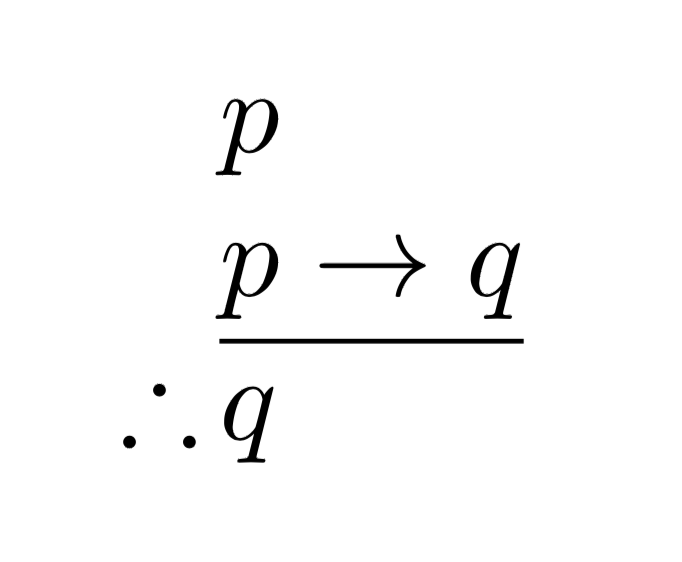
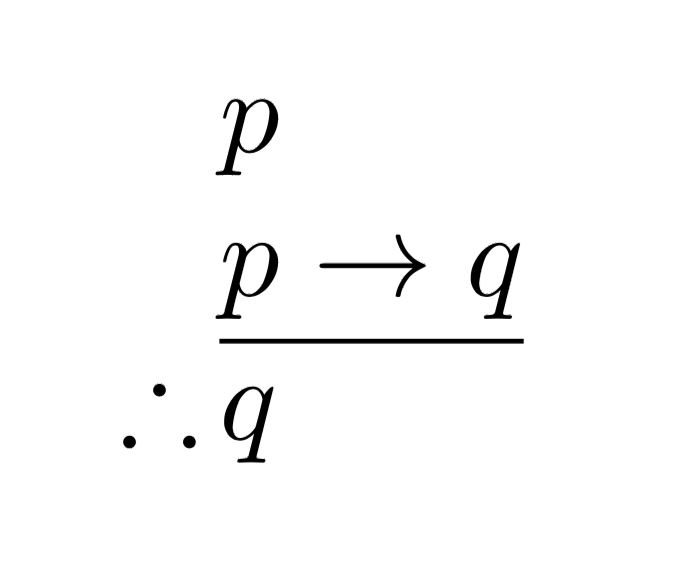
Which rule of inference guarantees that from 'If P then Q' and 'P', one can validly conclude 'Q'?
Modus tollens
Disjunctive syllogism
Modus ponens
B
Bb115
Books and cars
➕ Follow Author
📄 View Journals
>>
Followers:
7
Lifetime Tokens:
0
PHILOSOPHY
Logic
Logical Reasoning
Logical reasoning underpins everything from everyday decisions to advanced scientific discoveries
5 Feb 2026
0
What is the primary goal of logical reasoning in forming arguments?
To create arguments that are emotionally persuasive regardless of truth
To arrive at a conclusion supported by premises that any rational person would find convincing
To accept conclusions based solely on popular opinion without premises
P
Perfect_Peter_John_
➕ Follow Author
📄 View Journals
>>
Followers:
1
Lifetime Tokens:
0
MATHEMATICS
Logic
First-order Logic
First-order logic enables precise reasoning about objects and their properties using quantifiers
4 Feb 2026
0
What key feature distinguishes first-order logic from propositional logic?
The use of only true or false values without variables
The use of quantified variables and predicates over objects
The restriction to statements without any logical connectives
B
Bb115
Books and cars
➕ Follow Author
📄 View Journals
>>
Followers:
7
Lifetime Tokens:
0
PHILOSOPHY
Logic
Formal and Informal Logic
Logic bridges formal structures and everyday reasoning to reveal the principles of correct thought
2 Feb 2026
0
What distinguishes formal logic from informal logic in the study of reasoning?
Formal logic focuses on everyday language arguments, whereas informal logic uses symbolic systems to prove theorems.
Formal logic is concerned only with the truth of premises, while informal logic ignores argument validity.
Formal logic analyzes argument structure using formal languages independent of content, while informal logic studies natural language arguments and fallacies.
B
Bonbo
Me as you
➕ Follow Author
📄 View Journals
>>
Followers:
6
Lifetime Tokens:
0
PHILOSOPHY
Logic
Deductive Reasoning
Deductive reasoning guarantees truth when premises are true, forming the basis of logical certainty
28 Jan 2026
0
What distinguishes a sound deductive argument from a merely valid deductive argument?
A sound argument is valid and has all true premises, guaranteeing the truth of the conclusion.
A sound argument only requires the conclusion to be true, regardless of the premises.
A sound argument is valid but may have some false premises.
B
Brewster
Brewster
➕ Follow Author
📄 View Journals
>>
Followers:
7
Lifetime Tokens:
7
PHILOSOPHY
Logic
Rules of Inference
Rules of inference form the logical backbone ensuring conclusions follow from true premises
27 Jan 2026
0
Which rule of inference allows one to conclude the negation of a premise if the negation of the conclusion is known, given an implication?
Modus ponens
Modus tollens
Disjunctive syllogism
B
Bonbo
Me as you
➕ Follow Author
📄 View Journals
>>
Followers:
6
Lifetime Tokens:
0
PHILOSOPHY
Logic
Abductive reasoning
0
Abductive reasoning uncovers the simplest and most likely explanations from incomplete observations
26 Jan 2026
Abductive reasoning uncovers the simplest and most likely explanations from incomplete observations Abductive reasoning is a form of logical inference that aims to find the simplest and most likely explanation for a given set of...
1
112112112John
Author has not completed a profile
➕ Follow Author
📄 View Journals
>>
Followers:
0
Lifetime Tokens:
0
PHILOSOPHY
Logic
Inductive Reasoning
Inductive reasoning forms probable conclusions based on evidence rather than absolute certainty
26 Jan 2026
0
What distinguishes inductive reasoning from deductive reasoning in terms of the certainty of their conclusions?
Inductive reasoning produces certain conclusions, while deductive reasoning produces probable conclusions.
Inductive reasoning produces conclusions that are probable based on evidence, while deductive reasoning produces conclusions that are certain if the premises are true.
Both inductive and deductive reasoning produce conclusions that are equally certain regardless of the premises.
B
Bonbo
Me as you
➕ Follow Author
📄 View Journals
>>
Followers:
6
Lifetime Tokens:
0
PHILOSOPHY
Logic
Syllogism
How the minor premise connects specific cases to universal truths in logical arguments
25 Jan 2026
0
In a syllogism, what role does the minor premise play in reaching a conclusion?
It provides a specific statement that relates to the general statement in the major premise.
It states the final conclusion derived from the argument.
It contradicts the major premise to test the argument's validity.
B
Brewster
Brewster
➕ Follow Author
📄 View Journals
>>
Followers:
7
Lifetime Tokens:
7
PHILOSOPHY
Logic
Formal Logic
Formal logic reveals the pure structure of reasoning beyond specific content or topics
24 Jan 2026
0
What distinguishes formal logic from informal logic in the study of reasoning?
Formal logic studies argument validity based on structure alone, using formal languages, while informal logic deals with natural language arguments and fallacies.
Formal logic focuses on the content and topics of arguments, whereas informal logic ignores content.
Formal logic only studies invalid arguments, while informal logic studies valid arguments.
B
Bonbo
Me as you
➕ Follow Author
📄 View Journals
>>
Followers:
6
Lifetime Tokens:
0
PHILOSOPHY
Logic
Syllogism
Syllogisms reveal how conclusions logically follow from two assumed truths in deductive reasoning
24 Jan 2026
0
In a syllogism, what ensures that the conclusion is necessarily true if the premises are true?
The logical structure of the syllogism
The truth of the conclusion independent of the premises
The number of premises being more than two
B
Brewster
Brewster
➕ Follow Author
📄 View Journals
>>
Followers:
7
Lifetime Tokens:
7
PHILOSOPHY
Logic
Logic Translation
Logic translation reveals hidden structures in everyday language to clarify reasoning
24 Jan 2026
0
What is the main benefit of translating natural language statements into formal logic?
It simplifies the language to make it more understandable to everyone.
It replaces all natural language with mathematical equations for computation.
It reveals the logical structure of arguments, allowing precise assessment of their validity.
B
Bonbo
Me as you
➕ Follow Author
📄 View Journals
>>
Followers:
6
Lifetime Tokens:
0
PHILOSOPHY
Logic
Rules of Inference
How rules of inference form the backbone of valid logical arguments
22 Jan 2026
0
Which of the following best describes the role of modus ponens in formal logic?
It allows deriving the antecedent from a conditional statement and its consequent.
It allows concluding the negation of a statement from the negation of its antecedent.
It allows deriving the consequent from a conditional statement and its antecedent.
B
Bonbo
Me as you
➕ Follow Author
📄 View Journals
>>
Followers:
6
Lifetime Tokens:
0
PHILOSOPHY
Logic
Deductive Reasoning
Deductive reasoning guarantees truth when based on true premises and valid logic
22 Jan 2026
0
What distinguishes deductive reasoning from inductive reasoning in terms of the certainty of conclusions?
Deductive reasoning guarantees the truth of the conclusion if the premises are true, while inductive reasoning only suggests probable conclusions.
Deductive reasoning is based on specific observations, whereas inductive reasoning starts from general principles.
Inductive reasoning always leads to certain conclusions, unlike deductive reasoning which is probabilistic.
B
Bonbo
Me as you
➕ Follow Author
📄 View Journals
>>
Followers:
6
Lifetime Tokens:
0
MATHEMATICS
Logic
Probabilistic Logic
0
Probabilistic logic blends probability and traditional logic to reason under uncertainty
22 Jan 2026
Probabilistic logic blends probability and traditional logic to reason under uncertainty Probabilistic reasoning is a method of reasoning that incorporates the principles of probability theory to handle uncertainty in logical inference. Unlike classical logic, which...
B
Bonbo
Me as you
➕ Follow Author
📄 View Journals
>>
Followers:
6
Lifetime Tokens:
0
PHILOSOPHY
Logic
Syllogism
Syllogisms reveal the power of deductive reasoning through structured logical arguments
21 Jan 2026
0
In a syllogism, why must the conclusion necessarily follow from the premises?
Because the conclusion is logically derived from the premises assuming they are true
Because the conclusion is always true regardless of the premises
Because the premises are proven by the conclusion
B
Bonbo
Me as you
➕ Follow Author
📄 View Journals
>>
Followers:
6
Lifetime Tokens:
0
PHILOSOPHY
Logic
Syllogism Validity
Understanding syllogism validity reveals the core of deductive logical reasoning
20 Jan 2026
0
What distinguishes a valid syllogism from an invalid one?
A valid syllogism always has true premises and a true conclusion.
A valid syllogism has a logical form where the conclusion necessarily follows from the premises.
A valid syllogism is one where the conclusion is believable regardless of the premises.
×
Comments
Loading....
Share comment
5
Streak Win!
Game Over